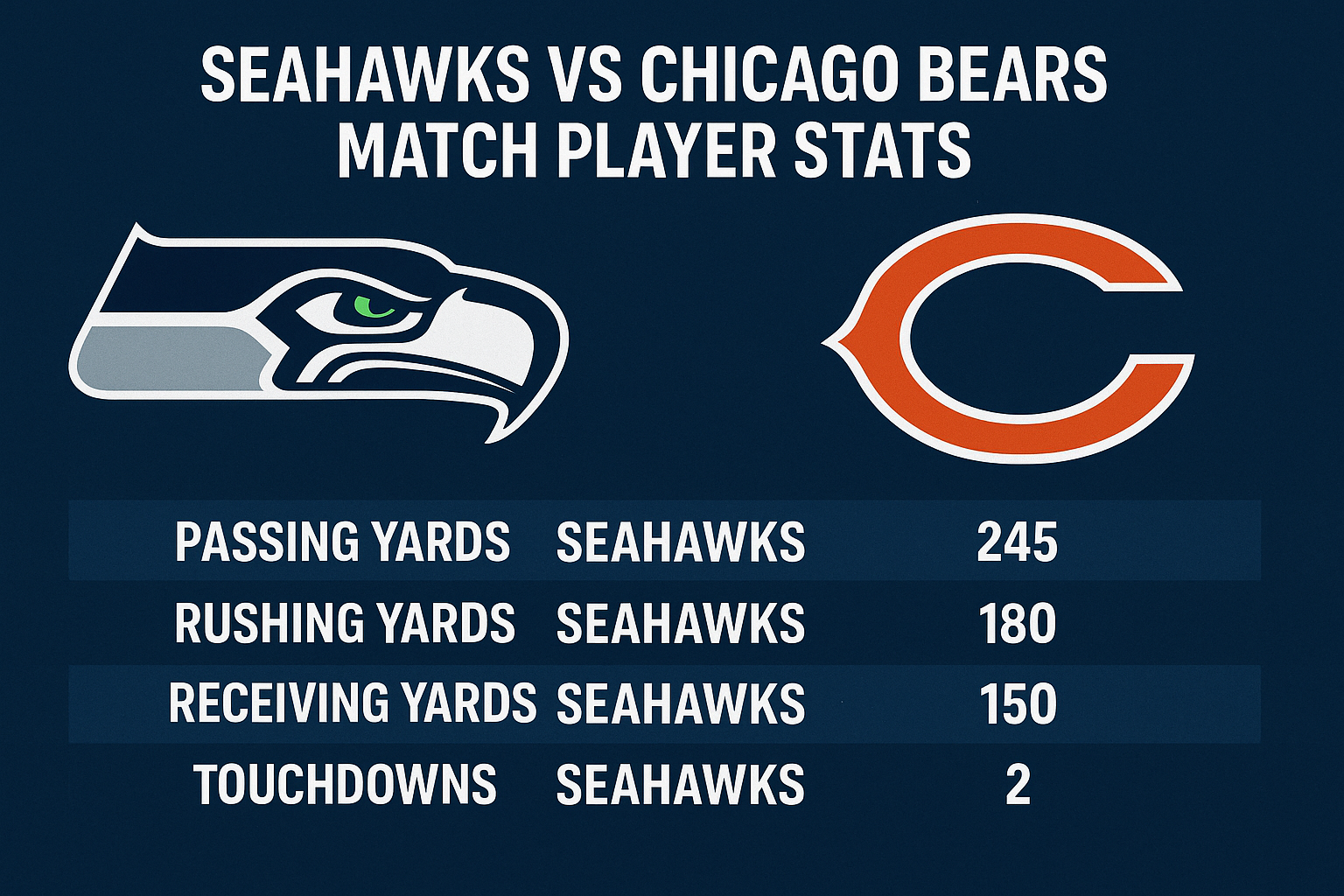
The NFL has produced countless iconic matchups, but few deliver the type of excitement, unpredictability, and competitive spirit that define the Seahawks vs Chicago Bears games. Whenever these two franchises meet, fans anticipate a physical, high-energy showdown driven by strategic coaching, explosive playmaking, and exceptional athletic talent. In this comprehensive guide, we dive deep into the Seahawks vs Chicago Bears match player stats, exploring standout performances, historical context, tactical insights, and the evolving rivalry between these NFC competitors.
Whether you’re a stats-driven fan, a fantasy football enthusiast, or simply someone seeking high-quality content for NFL analysis, this article gives you a complete, polished, and unique perspective on the matchup.
Historical Background and Importance of the Seahawks–Bears Rivalry
Although the Seahawks and Bears do not share a divisional rivalry, their meetings throughout NFL history have consistently delivered compelling narratives. These matchups often feature a clash of football philosophies: the Seahawks known for their aggressive defensive identity and dynamic quarterback play, and the Bears celebrated for their tradition of dominating defense and hard-nosed football. Because these franchises have experienced periods of dominance at different times, each game brings a new storyline.
Looking back at the late 2000s and early 2010s, the rivalry gained additional significance as both teams battled for playoff positioning. Memorable playoff meetings, including the 2006 postseason clash, set the stage for the respect and competitiveness that continue to define this matchup. Evaluating Seahawks vs Chicago Bears match player stats helps us understand how individual talents shaped these iconic games and how specific performances shifted momentum.
Quarterback Performances: The Heart of the Match Stats
The quarterback position always takes center stage, and that remains true in any contest between Seattle and Chicago. When analyzing Seahawks vs Chicago Bears match player stats, the quarterbacks’ ability to manage pressure, create explosive plays, and protect the football becomes a central factor in the final outcome.
Over the years, Seahawks quarterbacks, including Russell Wilson, Matt Hasselbeck, and more recently Geno Smith, have brought distinct strengths. Wilson’s mobility and improvisation often stressed the Bears’ defensive assignments. Hasselbeck’s veteran presence and accuracy added stability to the passing game.
The Bears, meanwhile, have seen quarterbacks like Jay Cutler, Mitch Trubisky, and Justin Fields bring varying styles: Cutler with his strong arm but inconsistent decision-making, Trubisky with athleticism and short-game efficiency, and Fields with elite dual-threat capabilities. These differences significantly influence passing yard totals, third-down conversion rates, red-zone efficiency, and turnover ratios.
In many matchups, a quarterback’s performance is the tipping point. For example, games where Wilson extends plays outside the pocket often result in higher passing yard totals and elevated team scoring. Conversely, Bears quarterbacks tend to succeed when Chicago controls the tempo through a balanced offensive approach. Studying the Seahawks vs Chicago Bears match player stats makes it clear that QB play, more than any other position, drives the game’s narrative.
Running Game Impact: Ground-and-Pound Meets Speed and Balance
Both teams traditionally emphasize the running game. Seattle has produced standout running backs like Marshawn Lynch, Chris Carson, Rashaad Penny, and Kenneth Walker III. Chicago counters with legends like Matt Forte, Jordan Howard, David Montgomery, and Khalil Herbert. The running game often sets the tone for physicality, ball control, and time of possession.
When breaking down Seahawks vs Chicago Bears match player stats, the rushing category becomes essential. In games where the Seahawks achieve over 100 rushing yards, their offensive play-action attack becomes vastly more effective, creating space for downfield throws. Marshawn Lynch, known for his punishing “Beast Mode” runs, frequently tilted the momentum in Seattle’s favor.
The Bears also rely on their backfield to control tempo. When Chicago’s rushing attack crosses the 120-yard mark, its offense becomes multidimensional, reducing turnover risk and enabling efficient game management. Matt Forte in particular delivered exceptional dual-threat performances, adding receiving yards that frequently challenged Seahawks linebackers.
An analysis of these matchups proves that whichever team wins the ground battle often secures the scoreboard advantage.
Wide Receivers and Tight Ends: Game-Changing Playmakers
The aerial attack in this rivalry has featured top-tier pass catchers whose production significantly affects the overall Seahawks vs Chicago Bears match player stats. For Seattle, stars like Doug Baldwin, Tyler Lockett, DK Metcalf, and Jermaine Kearse have created explosive moments. Baldwin’s precise route running, Lockett’s deep-ball efficiency, and Metcalf’s physical dominance bring different dimensions that Bears defenders must account for.
The Bears have relied on playmakers such as Alshon Jeffery, Brandon Marshall, Allen Robinson, Darnell Mooney, and Cole Kmet. Each brought unique skills: Jeffery’s size, Marshall’s physicality, Robinson’s reliable hands, and Mooney’s speed all impact match player statistics such as yards after catch, red zone targets, and completion percentages.
Yards per reception, catch rate, and explosive plays of 20+ yards often determine offensive success. In many of the more recent matchups, Metcalf or Lockett made crucial plays to extend drives. On the Chicago side, big-body receivers have historically created matchup problems against Seattle’s secondary.
Evaluating these metrics gives a deeper understanding of how receivers influence the scoreboard and overall team performance.
Defensive Dominance: Tackles, Sacks, and Turnovers
No analysis of Seahawks vs Chicago Bears match player stats is complete without examining defensive contributions. Both teams are known for iconic defensive units. Seattle’s “Legion of Boom” era, led by Richard Sherman, Earl Thomas, Kam Chancellor, and Bobby Wagner, created some of the most suffocating defensive performances in modern NFL history. Chicago’s defensive legacy includes legends like Brian Urlacher, Lance Briggs, Julius Peppers, Khalil Mack, and Roquan Smith.
When these units collide, defensive stats frequently dominate the storyline. Sack totals, forced fumbles, interceptions, and tackle counts dictate the flow of each matchup. For example, when Seattle’s pass rush succeeds in collapsing the pocket, Bears quarterbacks often struggle under pressure, reducing completion percentages and leading to turnovers. Conversely, the Bears’ aggressive defensive fronts have historically disrupted Seattle’s pass protection, forcing hurried throws and limiting deep-ball production.
Analyzing these defensive match player stats reveals how a single big play—an interception returned for a touchdown, a strip-sack, or a goal-line stand—can shift momentum permanently.
Special Teams: The Hidden Statistical Edge
Special teams rarely receive as much attention as offense and defense, but they play a crucial role in determining field position and momentum. The Seahawks vs Chicago Bears match player stats often show strong contributions from kick returners, punters, and field goal units.
Seattle’s special teams units have included elite returners like Tyler Lockett, who consistently flips field position with speed and vision. Their kickers, whether Steven Hauschka or Jason Myers, contribute important points in close matchups. Punting statistics, especially directional punting and net yard averages, also shape the game.
The Bears have their own special teams legacy, including Devin Hester—widely regarded as the greatest return specialist in NFL history. His presence alone changed opposing game plans. In more recent matchups, Chicago’s kicking game, led by players like Robbie Gould and Cairo Santos, has added reliability.
Reviewing special teams stats such as kickoff returns, punt averages, and field goal percentage shows how hidden numerical advantages add up over four quarters.
Key Moments That Defined Recent Matchups
Every meeting between these teams includes defining moments—fourth-quarter drives, defensive stops, explosive plays—that significantly influence the final stats. In looking at Seahawks vs Chicago Bears match player stats, these critical plays become clearer.
For instance, in games where Seattle executed explosive offensive plays of 40+ yards, their winning probability spiked. Metcalf or Lockett often delivered highlight-reel catches that instantly changed the momentum. Similarly, Chicago’s defense has produced game-changing forced fumbles or interceptions, especially when battling at home in Soldier Field’s unpredictable weather.
These notable moments aren’t just exciting—they directly correlate with statistical outcomes, such as total offensive yards, third-down efficiency, and red-zone scoring.
Coaching Strategies and Tactical Influence on Stats
Another key element of understanding Seahawks vs Chicago Bears match player stats is recognizing how coaching philosophies shape the numbers. Pete Carroll’s defensive-first mentality, paired with his emphasis on running the football, often results in balanced time-of-possession stats and conservative but explosive passing plays. His teams emphasize discipline, minimizing penalties, and turnovers.
Chicago’s coaching styles have varied widely, from defensive-minded approaches to offensive rebuilds. Coaching impacts player usage, target share, run-pass ratios, and defensive blitz frequency. For example, under certain coaching regimes, the Bears preferred short passing schemes that spread the ball among multiple receivers, reducing individual player yardage but increasing overall completion percentage.
Understanding coaching tendencies helps contextualize why certain match player stats appear the way they do and why specific patterns repeat over seasons.
Fantasy Football Insights from the Match Player Stats
For fantasy football players, analyzing Seahawks vs Chicago Bears match player stats provides actionable insights on potential performers. These matchups often generate standout performances from wide receivers, quarterbacks, and pass-catching running backs.
Seattle’s receivers typically deliver strong fantasy outputs due to their explosive play styles. Chicago’s defensive units, while strong historically, can be vulnerable to deep-ball threats. Meanwhile, Bears running backs and tight ends often benefit from short passing schemes, resulting in reliable fantasy production.
Turnover-heavy games, which are common in this matchup due to strong defensive pressure, often result in lower quarterback fantasy scores but boost defensive fantasy production. These insights ensure fans can make informed roster decisions.
Future Outlook: What to Expect in Upcoming Matchups
As both franchises continue to evolve, future Seahawks vs Chicago Bears match player stats will reflect the next generation of star athletes. Seattle’s young core, including emerging defensive talents and dynamic offensive playmakers, promises continued explosiveness. Chicago’s ongoing rebuild around a modern offense and young defensive leaders indicates their upward trajectory.
Future games will likely emphasize quarterback mobility, versatile running backs, and aggressive defensive fronts. Given the direction of both franchises, upcoming matchups may be faster, more open-field, and statistically higher-scoring than previous eras.
Why These Match Player Stats Matter for Football Analysis
Whether you’re a blogger, analyst, fantasy player, or everyday fan, the Seahawks vs Chicago Bears match player stats offer valuable insight into team strategy, player development, and competitive dynamics. Stats allow us to break down the game beyond the scoreboard—to understand why one team dominated the line of scrimmage, why a certain receiver was unstoppable, or how defensive adjustments shifted momentum.
These statistics help tell the story of each game, revealing strengths, weaknesses, trends, and game-shaping performances that casual viewers may overlook. For analysts, they offer data-driven storytelling. For fans, they amplify appreciation for the details that make NFL matchups thrilling.
Conclusion
The rivalry between the Seahawks and the Chicago Bears continues to deliver some of the most intense and strategically complex games in the NFL. By examining the Seahawks vs Chicago Bears match player stats, fans gain a deeper understanding of how individual performances shape team success. From quarterbacks and running backs to defensive units and special teams, every position contributes essential numbers that create the larger narrative of each matchup.
As these teams evolve, future showdowns promise even more excitement, high-level athleticism, and unforgettable statistical performances—ensuring the rivalry remains a must-watch fixture for football enthusiasts.
You May Also Read: Timberwolves vs Golden State Warriors Match Player Stats