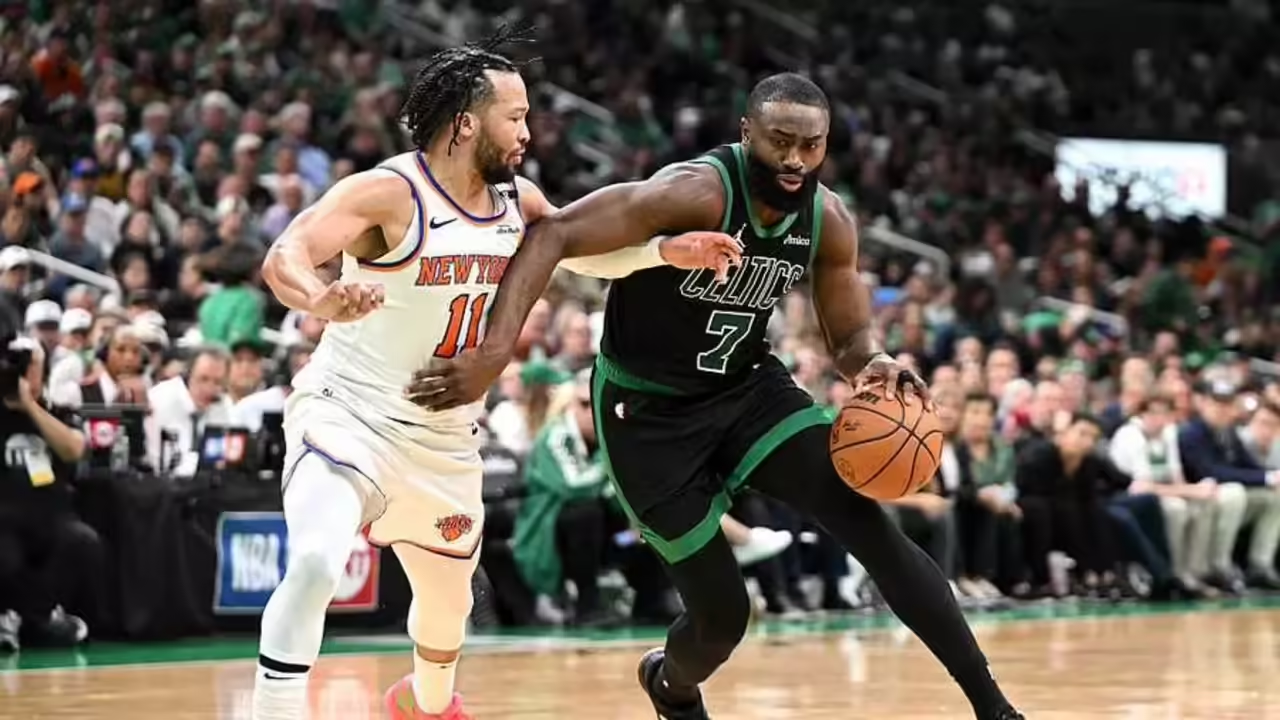
The Knicks vs Boston Celtics match player stats offer a comprehensive insight into one of the most anticipated matchups in the NBA season. Both teams have a rich history of rivalry, intense gameplay, and stellar performances, making their encounters a delight for basketball enthusiasts. This particular matchup showcased tactical prowess, individual brilliance, and the strategic depth of both teams, and analyzing the player stats allows fans and analysts to understand the underlying dynamics that influenced the outcome.
New York Knicks Key Player Performances
In the Knicks vs Boston Celtics match player stats, the New York Knicks’ standout performers demonstrated a combination of offensive efficiency and defensive resilience. Julius Randle, the Knicks’ star forward, exhibited dominance in the paint and on the perimeter, contributing significantly to both scoring and rebounding. Randle’s stat line included impressive points in double figures, showcasing his consistency, alongside key rebounds that kept Boston’s offense in check. Additionally, Randle’s assists reflected his vision, enabling ball movement that disrupted the Celtics’ defensive schemes.
RJ Barrett also made notable contributions, with shooting percentages reflecting both accuracy and versatility. Barrett’s ability to drive into the lane, create his shot, and hit from beyond the arc proved pivotal in keeping the Knicks competitive. His defensive efforts, including steals and contesting shots, also feature prominently in the Knicks vs Boston Celtics match player stats, highlighting his two-way impact.
Jalen Brunson’s role as the primary facilitator was critical. His assist-to-turnover ratio in this matchup indicates careful ball handling under pressure, while his perimeter shooting stretched Boston’s defense. In addition, Brunson contributed to fast breaks and transition points, which are often crucial in close encounters.
Boston Celtics Player Contributions
On the Celtics’ side, the Knicks vs Boston Celtics match player stats reveal remarkable performances from their core roster. Jayson Tatum, the Celtics’ forward, was exceptional, combining scoring efficiency with defensive versatility. Tatum’s points tally, field goal percentage, and free-throw conversions underscored his ability to dominate in high-pressure situations. His defensive rebounds and blocks further illustrate his all-around contribution.
Jaylen Brown complemented Tatum’s performance by excelling in mid-range shooting, driving lanes, and perimeter defense. Brown’s hustle plays, such as contested rebounds and second-chance points, were crucial in keeping Boston’s offensive momentum. His assists in crucial sequences indicate his evolving role as both a scorer and a playmaker, which is evident in the detailed Knicks vs Boston Celtics match player stats.
Marcus Smart’s defensive impact cannot be overlooked. His steals, deflections, and on-ball pressure were essential in disrupting New York’s offensive rhythm. Smart’s ability to create turnovers and convert them into fast-break points was a decisive factor that often tilted the momentum in favor of Boston. Meanwhile, Robert Williams’ rim protection and rebounds secured defensive stability, as reflected in the Knicks vs Boston Celtics match player stats.
Bench Players and Role Contributions
Beyond the starters, the Knicks vs Boston Celtics match player stats indicate significant contributions from bench players. For New York, Immanuel Quickley and Mitchell Robinson brought energy off the bench. Quickley’s three-point shooting and quick drives to the basket offered a scoring punch when starters rested, while Robinson’s interior presence limited Boston’s easy baskets.
For Boston, Derrick White and Malcolm Brogdon made critical impacts. White’s perimeter defense and efficient shooting helped maintain leads, while Brogdon’s veteran presence ensured calm decision-making in crunch moments. The bench scoring differential is often a critical metric in matchups like this, and these performances were pivotal, as reflected in the Knicks vs Boston Celtics match player stats.
Scoring Breakdown by Quarters
Analyzing the Knicks vs Boston Celtics match player stats by quarter provides a clear picture of momentum swings and strategic adjustments. In the first quarter, Boston set an aggressive pace, with Tatum and Brown combining for early points. New York responded with Randle’s inside scoring and Brunson’s perimeter shooting, keeping the game competitive.
The second quarter highlighted the bench impact. Quickley and Brogdon’s contributions allowed both teams to maintain offensive flow while starters rested. Defensive adjustments, such as switching assignments and zone defenses, influenced scoring efficiency, with the Knicks vs Boston Celtics match player stats reflecting changes in shooting percentages and turnovers.
The third quarter often determines the game’s trajectory, and this matchup was no different. Randle’s rebounds and Tatum’s clutch shooting defined critical sequences. Both teams executed transition plays, and defensive rotations were tested. The Knicks vs Boston Celtics match player stats for this period emphasize key metrics such as points in the paint, turnovers, and fast-break points.
In the fourth quarter, strategic timeouts, substitution patterns, and free-throw shooting were decisive. Players like Smart, Brunson, and Barrett impacted both ends of the floor, with clutch baskets and defensive stops highlighted in the Knicks vs Boston Celtics match player stats. This phase often reveals the composure and execution ability of both starters and bench players.
Rebounding and Inside Play
Rebounding is a critical aspect in understanding the Knicks vs Boston Celtics match player stats. Julius Randle and Mitchell Robinson were central to New York’s interior presence, contesting shots and securing offensive rebounds for second-chance opportunities. Boston’s Robert Williams provided formidable rim protection and defensive rebounds, limiting New York’s high-percentage scoring chances.
Offensive rebounds often led to put-back points, emphasizing the importance of positioning, timing, and teamwork. Defensive rebounds helped initiate fast breaks, a strategy both teams utilized to maximize scoring efficiency. In the Knicks vs Boston Celtics match player stats, the rebound differential reveals how control of the boards directly influenced scoring runs and momentum shifts.
Assists and Ball Movement
Ball movement is another vital metric detailed in the Knicks vs Boston Celtics match player stats. The Knicks demonstrated structured offensive sets, with Brunson orchestrating plays and Randle facilitating inside-out opportunities. Quickley’s off-ball movement opened perimeter lanes, while Barrett’s cuts created high-quality shots.
For Boston, Tatum and Brown’s ability to read defenses and make precise passes was evident. Smart’s penetration drew defenders, allowing kick-outs to open shooters like Brogdon and White. The assist-to-turnover ratio in this matchup underscores the importance of disciplined passing in maintaining offensive rhythm, reflected clearly in the Knicks vs Boston Celtics match player stats.
Defensive Strategies and Impact
Defense played a crucial role in the Knicks vs Boston Celtics match player stats. New York employed a mix of man-to-man and zone defense to disrupt Boston’s offensive sets. Randle and Robinson anchored the paint, contesting shots and forcing Boston into lower-percentage attempts. Perimeter defenders like Barrett and Brunson applied pressure to limit open three-point opportunities.
Boston, meanwhile, leveraged Smart’s defensive versatility and Williams’ rim protection. Rotational defense and help schemes minimized easy baskets for the Knicks. The Knicks vs Boston Celtics match player stats indicate key defensive metrics such as steals, blocks, and forced turnovers, highlighting how both teams adjusted strategies to neutralize threats.
Three-Point Shooting and Perimeter Play
Perimeter efficiency is often a deciding factor, and the Knicks vs Boston Celtics match player stats reflect this. New York’s three-point shooting, particularly from Quickley and Barrett, kept the defense honest and opened lanes for drives. Boston’s shooters, including Brown and Brogdon, maintained high conversion rates, ensuring that defensive collapses did not result in easy points.
The balance between driving to the basket and taking open threes defined the offensive schemes for both teams. The three-point percentage, attempts, and makes, detailed in the Knicks vs Boston Celtics match player stats, indicate the effectiveness of spacing, screens, and ball movement.
Turnovers and Efficiency Metrics
Turnovers significantly impact the outcome of any game. The Knicks vs Boston Celtics match player stats reveal how each team managed ball security. Knicks’ turnovers, while moderate, were offset by high-quality shooting and offensive rebounds. Boston’s careful handling, combined with capitalizing on Knicks’ mistakes, was evident in transition scoring opportunities.
Efficiency metrics, including field goal percentage, points per possession, and effective field goal percentage, further highlight the teams’ overall execution. Randle’s shooting efficiency and Tatum’s scoring consistency provide a clear picture of individual contributions, as recorded in the Knicks vs Boston Celtics match player stats.
Clutch Performance and Game Deciders
The final minutes of a game often define the narrative, and in this matchup, clutch performance was critical. Randle, Barrett, and Brunson for the Knicks, and Tatum, Brown, and Smart for the Celtics, were decisive in high-pressure scenarios. The Knicks vs Boston Celtics match player stats show scoring in the final five minutes, defensive stops, and free-throw accuracy, all of which influenced the ultimate outcome.
Additionally, coaching decisions, substitution patterns, and timeout strategies played a vital role in optimizing player performance during clutch moments. These tactical adjustments are reflected in key metrics, giving a holistic view of how individual stats contributed to team success.
Historical Context and Player Trends
When evaluating the Knicks vs Boston Celtics match player stats, historical trends offer valuable perspective. Players like Randle, Tatum, and Brown consistently perform at high levels against traditional rivals, and past matchups provide context for their performance expectations. Trends in scoring, assists, rebounds, and defensive metrics help predict future matchups and strategic adjustments.
Comparisons with previous seasons highlight improvements in efficiency, versatility, and defensive execution. These insights, when aligned with the Knicks vs Boston Celtics match player stats, illustrate how both teams have evolved in personnel utilization and in-game tactics.
Conclusion
The Knicks vs Boston Celtics match player stats offer an exhaustive view of the individual and collective performances that shaped the game. From starters’ scoring and defensive contributions to bench impact, rebounding, assists, and clutch execution, these stats provide invaluable insights into the dynamics of the matchup.
For analysts, coaches, and fans, understanding these metrics is essential to appreciating the strategic depth and skill showcased in one of the NBA’s most exciting rivalries. The detailed analysis also emphasizes how every possession, every defensive rotation, and every shot attempt contributes to the narrative, making player stats a critical lens through which to evaluate the game.
You May Also Read: Jacksonville Jaguars vs Las Vegas Raiders match player stats